
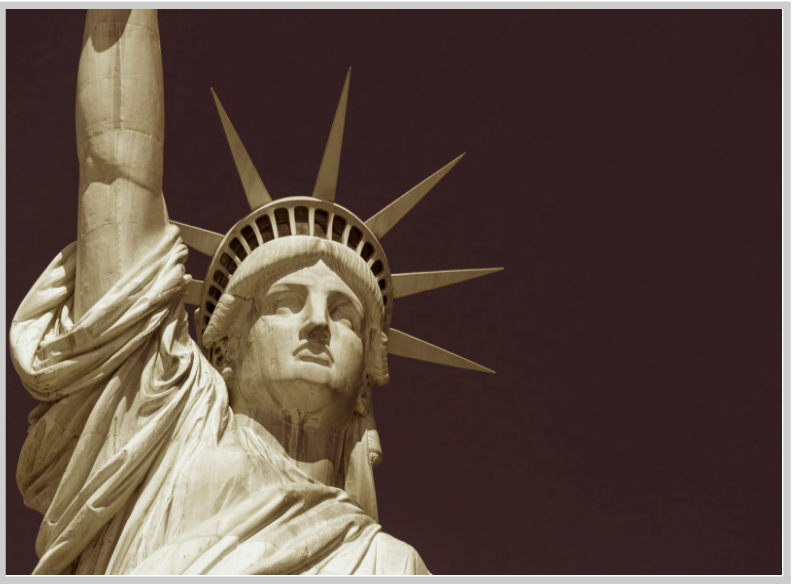
We suspected the neighbor might be the Statue of Liberty climbed down from the plinth and giving herself some much-needed rest. She was afraid of our dog, who nipped at her long silver skirt hem. Cardinals tried landing on her crown.
She moved in at the tail end of spring when the garage band that rented the yellow house next door went on tour. It was such a relief to have the night hours quiet again. Girl Scouts sold trefoils once more. The rabbits came back in colonies. This neighbor was resourceful and standoffish. She told us to call her Lib.
I wasn’t an Iowa native—far from it—but I liked introducing her to the region’s farm-like ways. We ate cheese from giant crock pots, talked about curds. We made early morning trips to Ace and Menards, asked red-vested clerks about first and last frost, how to put a nail in a plaster wall, hang a hummingbird feeder, measure out worm castings for seedlings.
Soon Lib’s yard overflowed with vegetation and vines. Morning glories, sunflowers, pink and yellow honeysuckle racing up the fence. Our block drew in squirrels and raccoons; moles, chipmunks, and possums. Lots of cats wearing bells on them. Birds galore. “You don’t have to be lonely out here,” I told her. “There are so many to feed.”
“Aren’t there always,” she said.
She didn’t pick any of her tomatoes in August, even when they gleamed and pulled branches to the ground. Instead, she let neighbor children harvest them, running them home in bright plastic mixing bowls. I told my husband her arms must be tired, all that standing and holding and reaching before.
Lib ordered liberally from the Home Shopping Network, sheepish when the packages piled up on her porch or appeared on our front steps from a nearsighted mail carrier. Her mail didn’t afford us any clues. We asked about her relatives in New York or France. She told us she’d moved from Tucson, which we didn’t believe. The bakery nearby made apricot-almond croissants that reminded her of her childhood in France, she said. I think she let that one slip.
“What do you think she buys all day?” my husband asked at the kitchen window.
Golden bracelets, I told him, gaudy rings, jewelry that clacked and clattered. Who wouldn’t after a life so well spent?
My husband thought about turning her in, calling someone in the government, but I told him we didn’t have evidence although my gut knew it to be true—she was who we thought she was. And she had escaped.
~
That fall, our black walnut tree got out of control, dropping more than leaves. Walnuts clogged the gravel alleyways, popping beneath truck tires, cracking into ragged halves seeping a dark brown dye. We wanted to embrace them, but they couldn’t be embraced. They were a nuisance like a cold sore.
One Sunday, a walnut cracked Lib’s windshield. She drove a silver Pontiac then, parked just outside the garage. My husband and I had to write her a five-hundred-dollar check. It had a picture of her on it, but if she noticed, she hid any recognition.
The next week brought strong, giant winds and a walnut branch fell in her yard. To be fair, it had landed on top of our fence, seesawing between our yard and hers. But it wasn’t just any branch—it was the heaviest and most massive—practically two-thirds of the tree. My husband and I couldn’t budge it, even with Lib’s help. Would a forklift lift it? Or a dozen chainsaws? Or maybe the fence will tumble, I thought. Meanwhile the branch was laden with walnuts, dropping them on both sides of the property line. Squirrels came to sit, rocking on it as they peeled. It was a ridiculous thing. My husband went inside to call debris removal.
Lib and I stared up into a white sun. The clouds moved in like a gray painting, like the death of summer, like a death. I looked at Lib in her long silvery robes, her special pointy crown, the one that interfered with the sun visor in her car.
I said, “You’re not fooling people here.” I’d meant it kindly, to let her know what to everyone else knew was true.
She blushed crimson, the deep red of a fallen tomato. “I’m tired.”
There were so many replicas of her in Times Square shops and the Paris Bateaux Mouches and even on the grounds of City High in our own small Iowa town. Why should she stand bare toed with sandaled feet, testing the cold winds from the Hudson? Why, she said, should she shoulder it all alone? Though lord, she missed Famous Ray’s. New York sure did that part right.
“Don’t you have to go back?” I asked.
“Because I’m a menace to this neighborhood?”
“Oh, no,” I said. She was as mild mannered as any Iowan who ever lived.
“Is the country here crumbling,” she said, “without me?”
“The country’s been crumbling long before you stepped off the pedestal.”
“Is the band coming home?”
I shook my head no. They’d gotten a standing gig in Echo Park. My husband saw on social media.
The newspapers assumed she was on vacation. Sort of like when you hadn’t seen Obama in the news for a while and folks started to wonder where he had gone. But then he’d resurface with jet skiing photos but also speeches and initiatives, harnessing justice, giving hope. “They’re waiting for you to resurface,” I said. “Hasn’t it been long enough?”
“I’m not a politician,” she said. “I didn’t choose this.”
“You’re an icon.”
“If people want to look at me, I can post a photo on Instagram.” She shifted into sarcasm. “Or put me on a stamp, nobody has ever done that before.”
She reminded me of my mom after the divorce, when so many people tried to talk her out of it.
The finances won’t hold up, they’d said, do you know how hard it is to be a woman alone? “Do you know anything about me?” Mom told them. “I’ve always been a woman alone.” I remember admiring her then, and now, because of it. Lib and I went through so many options I felt like a good friend and a terrible citizen.
I invited her in for soup, but she declined. I’d put two cups of lentils into the pot that morning, with carrot coins and mushy onion. I’d cooked it until it became mealy on the tongue.
“It’s lonely out there,” Lib said. She was tearing up by then, but tried to shield her face from me. “Don’t you ever want to burn it down, just start again someplace?”
Who hadn’t felt that way? We both stared at the fallen walnut branch.
“We could burn that,” I shrugged. I could go get my long-handled lighter, the one I used when our stovetop burners didn’t catch.
She looked at me with a spark. “Wait.” She galumphed into her yellow house, came back out with the torch. It wasn’t just a torch, gray, sculpted, shimmering—it was blazing. “I can do it,” she said, “but it might get the fence.”
And she lit it. The walnuts popped. The leaves went up and scattered, burning, like birds above the yard. She felt triumphant, I could tell.
My husband came out and saw the burning branch. He had a fire extinguisher at the ready.
“Wait—” I told him. The extinguisher was still poised, held aloft in his hand, and he watched the fire with us. The branch burned for a long time.
“It helps?” I said after a while.
Lib rubbed her hands together, and like my mom often did, turned her back to the flames, warming her backside. “Feels good,” she said.
“Are you rehabilitated?” my husband asked, but I knocked him with my elbow. He is a brilliant man but sometimes his sense of timing is off.
“Let her rest,” I said.
We stared into the flames.
That night I lied to my husband. She’s not the one from New York, I told him, the one who grew up in France. She spent most of her life in Tokyo Disney trying not to suffocate from repeat renditions of “It’s a Small World” and the Matterhorn theme.
I think he knew I was lying. But maybe not. “Did they sing it in Japanese?” he asked.
I shrugged. “You’ll just have to ask her sometime.”
~~~

Corey Campbell’s fiction has appeared in Story, The Gettysburg Review, Colorado Review, and the anthology Buffalo Cactus and Other New Stories from the Southwest. She has received support from the Sewanee Writers’ Conference, the Vermont Studio Center, the Iowa Arts Council, and the National Academy of Television Arts and Sciences.
 the museum of americana: A LITERARY REVIEW