
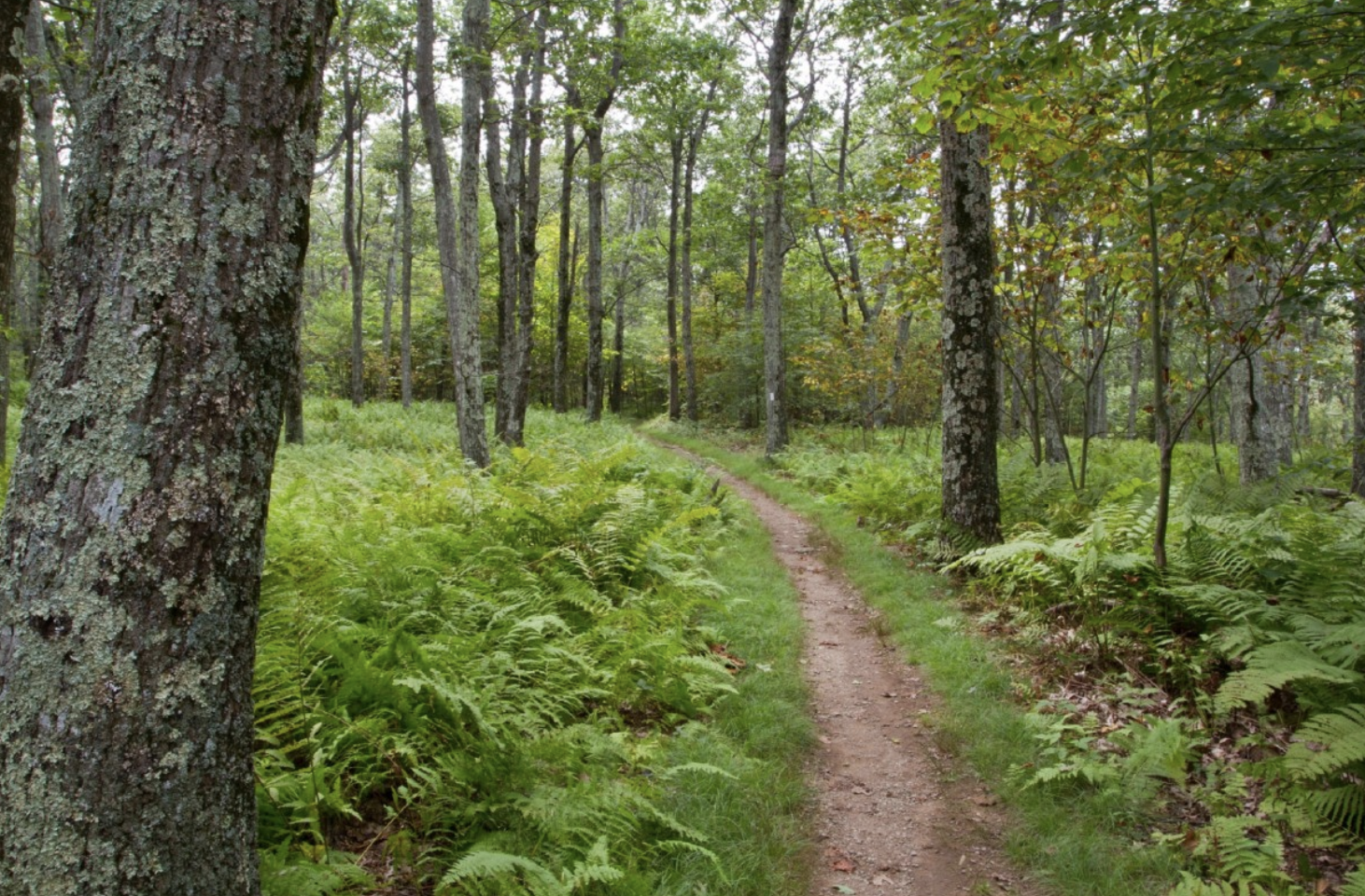
They gathered where the creek met the pines at the dead end on Landria Drive. They gathered with their calloused feet, bitten nails, knotted hair tied into lopsided ponytails sprouting stems out of the backs of their sticky necks. Some hands remained doused in the juice of prickly raspberries shoved into their palms by their mothers, catching them before they managed to slam the torn screen door and scurry off towards the trees. Some hands remained dry, stinging in the cracked hurt of skin against pavement.
They met here almost every day after lessons, when homeschooling books were tucked away and Cheez-Its finished. After knocking on doors, begging mothers, eyeing the clock until it reached the line that spelled out permission to “go on, go on.”
“They gathered with their calloused feet, bitten nails, knotted hair tied into lopsided ponytails sprouting stems out of the backs of their sticky necks.”
Most days the children didn’t have to wait long for each other before venturing into the woods. Other days, they chose a representative—usually Sally, the oldest—to fetch any stragglers, who might be making a concentrated effort bunny-earing their shoes or getting spanked by their mamma. The latter meant they wouldn’t be coming that day.
During the wait, the tempting apple of boredom was often bitten, revealing the same indulgences, sour in flavor and stale in feel. Tired of picking scabs, the youngest would take to hiding in the nearest bush, hoping to startle the latecomers. Some sat cross-legged on the hot asphalt edging along the trail’s source, ripping dull blades of grass between their pink hangnailed fingers.
Once all members of their battalion arrived, they set off into the woods for their journey. Three hundred yards down the gravel-poured path, past the weed-devoured clearing, until they could spot it from the distance. Now began their expedition down unmarked land, stepping over vines and weaving through trees, nicked by the brush. At last they came upon their colony: Stickhaven, they had chrestened it the summer before.
Anna, their de-facto leader, was always first to enter, ducking beneath the bowed branches into the first room of their hidden world. The foyur, they called it. For a wooded shelter built by little girls shunned from Cub Scouts, Stickhaven was divided into neat little rooms, each with their own purpose.
The first task of the day was always clean-up, a chore that continued intermittently until the last goodnaught the shelter, Sun spelling out six p.m. Drowning in eager afternoon chatter, the children fell silent as the daunting task of reorganizing the disturbed lay upon them—packing mud, brushing back leaves, maneuvering sticks at the right angle. They couldn’t play until everything was perfectly tidy. Chores at home were always met with rubber band tension—fought and fought until each child buckled under maternal threat. But at Stickhaven, they took pride in keeping house, creating order and beauty out of the tangled hair of the woods. They wanted to impress their parents, who they hoped would someday praise them for their good work. Realizing their elders were too weary to venture into the woods, they instead settled for unspoken competition.
Each member of Stickhaven had their own room, built as though from their own dust and grime. The rooms were not much larger than the hot pink miniature trampoline Anna and her brother Danylo had put a hole through in their basement earlier that year. Pliable branches and wispy trunks drew a circumference around a plateau of dirt, prints of Crocs maiming the smoothed-down earth. The children each took fastidious care to fashion their own rooms—constructing lean-tos, patting down beds of leaves. Mila took pride in arranging a floor pattern out of rocks; Katarina was set on constructing a three-inch wall of sticks.
One Saturday, the morning after a storm, Chloe dug up the stump of a cracked and fallen tree. She spent half an hour working at it with a butter knife, until, determined, she rushed back home and climbed the countertop for the steak knives kept in a higher drawer. By noon, the stump was in her designated bedroom. Indignant, Anna didn’t speak to her for three days, fuming at the ingenuity that spared Chloe from having to sit on muddy ground.
Anna already had enough trouble of her own—Danylo always begged to share her bedroom. Now that their mother finally let him come to Stickhaven this summer, Danylo struggled to keep up with the community’s societal structure. Being the youngest and the only boy, he didn’t have the knowledge to build a room from scratch or the respect required to build successfully. Eventually, Sally stopped coming, twelve years boring her out of tomboyish diversions and instead interesting her in dresses and her mother’s nail polish collection. Danylo, pleased every time Sally stayed at home, took her room as a residence—until the girls made it into a living room.
Anna set the agenda each day without fail. When another girl—usually Chloe or Vanja—offered ideas, Anna would crush it with a single snide judgment or morph it into her own. She didn’t understand how this affected the others; she just didn’t know how to exist without being in control. The younger ones were happy to oblige, seeing her as a figure that warranted the utmost respect.
Time at Stickhaven was spent in either work or play. Work was usually saved for the late afternoons of dried sweat and sore throats, when the children would rather work on their own than frolic in the woods. They often worked in silent merriment, renovating their own rooms or meandering in attempts to copy the others’ clever designs. Many days were spent foraging for nuts and berries for the hoped-upon occupants of the Animal Room; others were spent making paths and gathering the roots of poison ivy to place around the shelter’s perimeters. The outside world of civilization must be defended against—these walls could only nurture children and woodland creatures.
Eventually, Stickhaven’s residents became restless, irritated at nature’s lonely scarcity. Apart from the twine and clothespins they fished from their fathers’ office drawers, they were staunchly forbidden to take any home comforts to the woods. Their fantasies only grew, crooning melodies of velvet blankets and embroidered pillows. So they journeyed to Katarina and Vanja’s house, a stunted brick thing teetering over the edge of a small hill. Behind the hill was the neighborhood dumpster, carved into an asphalt space between sloped knolls. Climbing into the whale’s belly, the girls rummaged for anything warm and colorful. They came away with a no-sew Girl Scout charity blanket, two dog beds, a punctured bean bag chair with its pebbly guts half-spilled, a stained duvet cover, and bed bugs.
Isabella, the second youngest, often tried to elicit help for a fairy garden, until being reduced to tears by Anna and Chloe who claimed fairies weren’t real. Soon she directed her attention to a feat more tangible: convincing the others to help push down heavier trees to use for defensive walls.
The children saved a few lighter trees for a special occasion: Initiation. Occasionally, a member’s cousin or Sunday school friend would visit the neighborhood. But wanting to visit Stickhaven did not come without a price. As a newcomer arrived at the structure, one of the older girls fetched a thin trunk, laying it across two lone stumps. The newcomer was instructed to stand on top of the trunk, bouncing on it until it snapped. If successful, they became a full-fledged member. If they fell off or failed to break the trunk, they were forbidden from entering Stickhaven, and warned that if they did, they would be chased away with poison ivy.
Most often, the children busied themselves in play. A favorite was Prayer, a game treated with utmost gravity. Gathered in a circle, each child crossed their arms over one another and linked hands with their neighbor, visible muscles pulsing beneath once-soft skin. Imitating familiar pastoral fervor, they chanted impromptu thanks—We thank thee for the chipmunks…We thank thee for the pine tags…We thank thee for the poison ivy to protect us against park rangers…We thank thee for deer poop…
Despite their reared religiosity, these words were not directed at their God, but at the spiritual force that coursed through the woods. A force unspoken, but known to be as ever present and replenishing as the blood that flowed through their arteries, like the muddy water that trickled past the rocks of the creek.
Eventually, the girls developed their own system of writing. One day, Mila called out upon the shelter, inquiring if anybody had brought markers—she wanted to write the name “Stickhaven” on a sheet of bark above the entryway. No one had them. Vanja offered to spell it out using sticks in the dirt. But that wouldn’t do, and nobody wanted to return home to fetch a Sharpie. So they resolved to use blood, knowing from years of sleeping on nosebleed-stained bedsheets that it left a mark. The girls searched for the right sticks, ones that would be sharp enough to puncture tender flesh. By the end of that day, Vanja, Chloe, and Anna’s fingertips all had heartbeats, and Stickhaven had a sign. Soon the others began writing their own names above their rooms, learning to prick their fingers and squeeze. Using a stick as a quill, they reddened the nib and got to writing.
“The children craved this exoticism, yearned to experience a life detached from their own—swapping the love that produced baked bread and patchwork quilts for a hardened childhood of unhealed scars and total self-sufficiency.”
On sunny days they would play Dogs, descending on all fours, tracking palms and knees through unsympathetic mud. In Dogs, they took on the identities of abused mutts, banished to the woods by their cruel masters. Newly quadrupedic, they curled themselves into balls, whimpering in feigned hunger and mock hurt. Some shoved leaves into their mouths; some peed on the floor. Others gave false birth to a puppy, screaming away the contractions in their “tummy.” If the plot was lacking sufficient drama, they staged fights between the dominant dogs.
The fights were what they all enjoyed the most. Preparation ensued beforehand. Once opting to sharpen their nails with rocks, the children learned that placing pierced sticks between their fingers dealt more damage. As the fight began, everyone gathered round, contributing their yips to the growls of the combatants. The two children leaped at each other, scratching skin, tearing fabric. Inflicting the occasional bite. The fight ended when one started to emit the tail-tucking squeals of a dog in defeat. The injuries were minor enough that nobody was sent home, save for the time Chloe left a three-inch gash in Mila’s arm from a shard of glass she found in nearby brush.
The children craved this exoticism, yearned to experience a life detached from their own—swapping the love that produced baked bread and patchwork quilts for a hardened childhood of unhealed scars and total self-sufficiency. To escape the monotony of comfort for the dramatic, emotional, entertaining volatility of pain. They learned to wield this new sensation, testing its limits, manipulating its power. Its unfamiliarity made it a game to them, introduced the stakes and consequences that their sheltered lives lacked.
They contrived a game they called Drowning, bringing along their Spider-Man thermoses and plastic-peeled Deer Park bottles. One by one, the children lay down, pulled their shirts up over their heads, and allowed another to pour water over their faces. As water pooled into their nostrils, cloth threatened to press away the thick, damp oxygen that remained. Keeping track on a faulty Dora watch, they counted the seconds each drowner lasted, scratching a leaderboard in the dirt. Most preferred watching the spectacle rather than participating, but a few girls enjoyed the thrill of it, driven by the incentive to override their reflexes and last just a few seconds more.
Everything ended one winter when Anna became keen on starting a campfire, having received a wilderness guide for Christmas. The children cleared out a patch of smooth land neighboring Stickhaven, briskly gathering sticks and logs to nurture their unborn daughter, a small flame intended to warm their bluing hands. It took a few days of intermittent effort to get a fire started, let alone going. Finally, the flames began jumping, kicking up their heels in unrestrained savagery.
The fire caught the grass, fanning out towards Stickhaven, fanning out towards the woods. The children froze, and as the flames spread, realized there were no adults around to take action. Danylo took off in the direction of home, the girls following in mute terror, the only sound the one of cricket frogs hopping at muddy ankles, twigs snapping beneath feet, kindle for the drawing flames.

Emma Burris is a student at Barnard College of Columbia University in New York, NY. Originally from Richmond, VA, her main academic focus lies in psychology. Apart from writing, some of her favorite activities include reading ergodic literature and collecting records. She can be reached on Twitter at @ec_burris.
 the museum of americana: A LITERARY REVIEW