
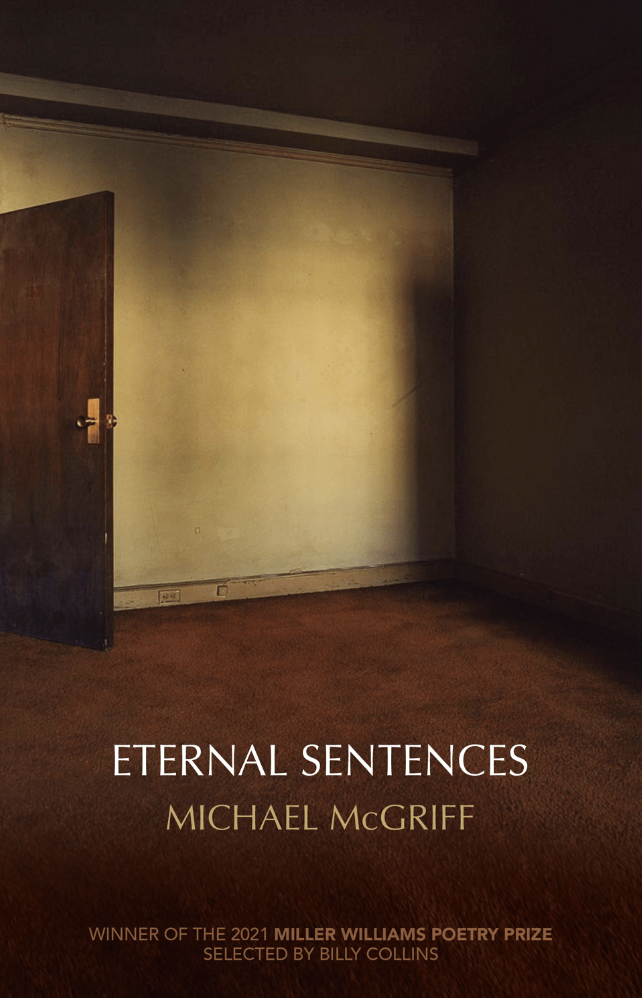
“Beyond the pavement where the gravel begins”: Michael McGriff’s Eternal Sentences
Michael McGriff, Eternal Sentences, University of Arkansas Press, 2021. $17.95.
The ripples from the 2016 presidential election built into a surge of speculation as to what, or who, went wrong. The swell culminated in a wave of journalists lighting out from major population centers to make sense of what they portrayed—often in condescendingly voyeuristic terms—as some wholly other country, diminishing the vast array of life that exists beyond suburbs or urban cores. The unfailingly achromatic, broad-brush narrative of deep-red-and-deep-blue has not much abated and still continues to leave plenty of gaps unexplored. This liminality is the perfect terrain for poetry to plant a flag and make a perhaps truer report from the territory than what passes for news; gaps are what poetry makes, what poetry employs in its composition, and where poetry resides.
Michael McGriff’s Eternal Sentences, winner of the 2021 Miller Williams Poetry Prize, is a close-to-the-ground exploration of the people and landscapes in his native southwest Oregon, told in a litany of disjunctive, associative, sometimes surreal short lyrics that revel in the ambiguity in the gaps between lines. Eternal Sentences is what a dispatch from rural America has the potential to be: as odd and desirous and urbane and dream-like as anywhere else, a reminder that wherever there is a mind there is a life of the mind. McGriff is here to draw us a map of one instance of that life in all its myriad dimensions. The collection’s ambiguity includes the unidentified, unidentifiable speaker that features in nearly all of the poems here, who possesses such James Wright-esque fatalism and nostalgia for some out-of-reach golden age that I can’t help but be endeared to them. The speaker is at once “a dusty boot print in a hotel lobby” (16), “[a] dead flashlight in a kitchen drawer” (25), “not quite the rain” (55), “a fiction that exists between a horse and a stand of white pines” and “buying tickets to the past” (34, 35); in the span of two pages, we go from “Campaign Promises” to “Concession Speech.” The effect is a gathering of poems that feel hued in passive earth tones, autumnal in their shading.
True to the collection’s title, every line is a single, short, declarative sentence. The individual-sentence-as-line creates a haunting, halting rhythm—reminiscent of Emily Kendall Frey’s Lovability or Kaveh Akbar’s “Pilgrim Bell” poems—where the figurative space surrounding each line is like a physical space to rest, ponder and move on, and evokes an organic rhythm akin to a slow walk or measured breathing. A sentence is a managed unit of writing or speech, or a sentence is the duration of recompense for wrongs committed. In both senses of the word, the sentence is a measure of time, a demarcation of a beginning and an ending. Eternal, on the other hand, is the opposite of time: it is recurrence, circularity. Appropriately, McGriff’s poems also swim in a kind of back-and-forth circuity, between temporal and eternal, surreal and quotidian, embellished by the piling on of images often disparate, yet by virtue of their grouping-together, conforming to construct an emotional tenor. Each poem then is a microcosm of the collection: brief, individual statements that coalesce in a three-dimensional portrait of one unsung corner of the world in all of its strangeness, mundanity, and collective longing. The diction and syntax are largely straightforward; it is the image that does the transformative heavy lifting throughout.
In his essay “Association in Poetry” Carl Phillips writes: “[t]he gathering together of images can be likened to a musical chord, several notes held simultaneously to produce a meaning that in music is called harmony” (93). The chords that McGriff strums here—his eternal gathering of sentences, of images within those sentences—feel like suspensions, chords neither major nor minor, a harmony that floats and does not imply any sense of resolution. Consider these opening lines of the title poem, which opens the book:
A motion beneath the pond scum.
I know how the moon got its black eye.
It happened last night.
It transpired in the wind.
Crows as pure as lies were involved.
They factor into the wind’s accent.
My father throws a fouled sparkplug in the millpond.
Then another.
And another.
He cut a slit in the fence to get us here.
It was like stepping through a gill. (3)
In these opening eleven lines McGriff lays out an ethos and an aesthetic. The tones here are at once nocturnal, mechanistic, and familial. There’s a dark coldness in the wind, the crows, the scummed-over pond, the night, the moon with its black eye; there’s heat in the sparkplugs, in the hand upon them, the fatherly curation of trespass, the bodies slipping through the fence, the fence-slit like a gill. It’s tactile, sensorial: the wind’s accent is heard and the wind is, by conjecture, felt; the fence’s chain-links rattle with each passage, footsteps crunch the ground, sparkplugs plunk the water like haiku frogs. The landscapes of these poems are those oft-hidden American spaces where the human and nonhuman are not sequestered but interweave each other, where gravel or dirt are the kinds of surfaces one is more likely to tread upon than pavement.
Eternal Sentences does wonderful work toward populating human-rural space with a too-often unseen magic, going so far as to endow the wind, the moon, and the seasons with an agency, determination, or stark emotional life that parallels these poems’ human players: “The creek’s so low it barely complains” (4); “The elk sharpen their craft of disregarding us / On the far shore they are both memory and experience…The wind undresses across the water. / It has never lied about what it doesn’t know” (13); “The season lost a good eye in a fair fight” (20); “a hopeless star registers a complaint” (38); “The moon skulks around the crepe myrtle” (40). These are but a few of the instances in Eternal Sentences of the natural world interweaving the civilized. It’s an insistence that this region is enigmatic: crows, owls, and elk, water and wind, are as animate and flawed as the humans in these poems, including the speaker that witnesses and manifests. It’s easy to imagine such a move degrading to trite anthropomorphism, but McGriff’s paratactic leaps and the electricity therein give these moments a sense of necessity, a vitality that endows the collection with momentum.
No doubt there are hardships portrayed in these pages; there are untimely deaths, arrests, strained parent-child relationships. But there’s also a backwater richness at play in these poems measured not in dollars but in encounters, a wealth of imagination and a variety of sight from outside the limited purview of what cosmopolitans might consider “mainstream” society. Eternal Sentences urges the reader to see American society as a braided river with multiple parallel channels flowing simultaneously, separate and in union, whether our collective destination be holy or hellish. This is darkness and light held in suspension; it is life, mainstream or otherwise. This collection is an illustration of one of those American rivulets, gravelly and gleaming in its intermittent shade.
Marko Capoferri is a poet, musician, and former conservation worker. He has lived and worked in eight US states, including Montana, where he has lived since 2015. He earned an MFA in poetry from the University of Montana in Missoula. His work has appeared in Porter House Review, Painted Bride Quarterly, Anti-Heroin Chic, Opt West, and elsewhere.
 the museum of americana: A LITERARY REVIEW