
We spent the early morning scrounging for change.
I never knew if we found enough. The only thing I remember finding was a quarter under a sagging La-Z-Boy. Some black residue was stuck to one side, towards the bottom. I wiped it away with my finger. I saw it was minted in 1965 and that the body was unusually shiny, despite the dust, the cobwebs, the black gunk now stuck on my finger like glue.
Duck came by and plucked the coin out of my hand. He handed me his pipe. It was multi-colored, shaped like a wingless dragon, its belly ready to bloom if you drew from its tail. There was a little bit of spice in it.
“Hold down the fort,” said Duck.
“Okay.”
Duck nodded to Roger, who opened the sliding glass door, and they left. Outside there was a slight shimmer in the air. It was hot.
Paul emerged from the bathroom. There was no flush of the toilet—his pupils were dilated, his hair was perfect, slicked back like some hotshot from California, just the same as it was before he entered the bathroom. He was still gently caressing his hair with his fingertips.
“They go to get more spice?”
“Yeah,” I said. “We got the last bit for now.”
*
The TV hummed in the background.
A mere two hours ago, I had declared that I would never smoke spice again. Now I was here, at Roger’s house, smoking spice from a dragon’s belly. Paul and I passed it back and forth while staring out the sliding glass door. Before us, a pool glimmered. Tree leaves rustled in the wind, silently shifting into one another as one formless, rippling mass, like some obscene green brain baking in the sun. Soon, we’d be finished with school.
“You know, I’m going to make movies one day,” said Paul.
I took a hit and handed Paul the pipe. “Show me.”
Paul took the pipe. He stood there for a moment, staring at the darkening black lump in the pipe, the same residue that would cement itself into the dragon’s innards as the day wound on. And, standing there, facing his own perfect reflection in the glass, it was as if he didn’t know what to do—what to say to me.
But he did.
“All right.” He puffed on the pipe, took it into one hand. With his other hand he took the pool in a right angle, put it in half a frame. “Imagine,” he said, “a shot of the pool. Inside the pool, but focused only on the side of it. You can see the rim and the water. The light—those little lights, those reflections—bouncing around the side. You can’t see anything else: nothing above, nothing below. You can see the sun shining off the water.”
I looked at the pool. I imagined.
“Then the camera begins to move. Very slowly. And as it moves away from the side, you can see it in the water: a dead body floating. Belly up. All of these very close shots, from the very start. Most movies start with a wide shot. Establishing it, you know? Not here. Claustrophobic. A dead body in the water. So much of it, you know? The water.” He tapped the pipe. Almost as an afterthought: “The camera is so slow. But it begins to rise. And sitting at the pool’s edge is a woman’s foot. And her hand. Only that. She’s painting her toenails.”
“Why is she painting her toenails?”
“She’s painting them black,” said Paul. He nods his head. “Black.”
I looked out at the pool. I tried to place myself there, to see the projection of myself that was reflected back to me in the pool, deep inside of it. And I did see myself: my cheeks sunken, my eyes burnt out, a person I both barely recognized but that felt, in some ways, correct, except for one realization: I did not belong there, in the window. I belonged, I thought, in the pool. Something about sinking in the water—something about the homogeneity of water being all around me; something about the depth and the impending darkness. I tried to place myself there. I reached out a hand, as if to mimic Paul, but really I was simply trying to touch myself. But the mere act of this caused the reflection of me to flitter away in the dirty glass.
“Do you see it?” said Paul.
I was left only with the empty pool. “I do.”
“Good.”
The TV droned on. Paul handed me the pipe. It was spent.
*
Poolside. I tend to remember the water as if caught in an early summer sunset. The waves, gently lapping up the light, pale orange like melted Sherbert. Beneath it the gentle blue of a clear day gracefully receding, as if the pool could take the sky in. But none of this was true—the pool was dumped full with chlorine, and it was an aggressive, gurgling blue. What it gave back was lurid.
Roger burst from under the water. His hair was plastered flat to his head, his teeth bared in wild disarray, having never once seen the wire of a brace. He made some sort of gurgling sound, as if he had swallowed water, and in fact, water came bubbling sickeningly from his mouth, like some sort of punctured human fountain.
We were all high again.
I watched the water dripple down Roger’s body into the pool. I realized how much I loved this: the water, the pool, the wet, the deep. There was the promise of a mystery at the bottom. Even here, in this place, enclosed by the concrete of the pool walls, there was some secret, some sense of the unknown.
I jumped in.
My body rocked. My head swelled. It felt like something in the back of my brain was popping, blood vessels finally giving way to the tail end of another spice high, and in the pain and pressure there was a sick thrill. I opened my eyes. Here, under the water, it was like opening your eyes for the first time after being born. Brief stasis: the freakish blue light of the pool ebbing in some slow rhythm, shapeless black marks above bleeding sunlight. I began to push myself further downwards. My hands parted water in front of my eyes, water that I knew was there, and I kept going on in this way, driven by the popping in the back of my brain, and the only way I knew I was moving was through the sensation of the water both parting from my motion and because I could see the bottom of the pool—the flat nothing of it. The sensation in my head numbed. My body totally enveloped in water. Me, sinking, ever closer to the bottom, the only thing in my vision, immutable, and then I reached out.
I touched the bottom.
The throbbing of a vein in my head. The rough edges of a flat surface at my fingertips. Unyielding paradox.
No one was coming.
I could die down here.
I let the air out of my mouth: an agonized scream unheard, the bubbles floating, and as my sight went to black I was lifted with the bubbles as though carried away by the silent scream.
And then I was at the top, gasping for air. I do remember the pale disc of the burning sun hanging there as though it would never move. It was afternoon, morning, evening—time did not matter. Everything was too bright. Roger was laughing at me. “What were you doing down there?” he said.
I blinked, shook the water from my eyes. I was still treading water in the deep end. I looked around. Paul was sitting at the pool’s edge, only dipping his toes in. Duck was floating on his long, acne-scarred back, his stomach sunken in. His eyes were closed and his hair was pooling out behind his head, resting on a surface that wasn’t there. I continued to kick my feet, squinting in the sun. Duck continued to float. Soon, his head became parallel with mine, his hair swaying underneath him still, little strands reaching for the deep—and I imagined them as veins in his head popped out the back of his skull, reaching for something greater, something beyond reckoning, something so desirable and something that they could only touch for the briefest of moments. Then, suddenly, one of Duck’s bloodshot eyes lolled open.
I think he was trying to look at me.
*
When we were done, I called my mother to come pick me up. Some barely thought out lie that worked. The next day, we did it all over again—only this time I got caught. My mother had phoned the school that same day, promising to bring me the lunch that I had left back home.
So now it was the end of the day, the weekend coming up. I was outside with my father. My mother was inside weeping. The sun was receding gracefully behind the soft leaves of a boxelder tree, it’s bent back leading up to a blackening penumbra. I was in the bottom of a burn pit with a shovel, staring at the leaves, at a sun barely there. Years later, the tree would be sawn down.
There was a pop. I winced. The fizzle of a beer. I watched the foam run off the worn-down arm of an old lawn chair.
“What have you stopped for?” said my father. He was sitting in the lawn chair above the burn pit.
“I need a break,” I said.
“A break.” My father took a sip of his beer.
I glared at my father. Then I took the shovel and drove it into the dirt. It was hard, cold, despite the fact the day had been unbearably hot. I had been here while the sun was hanging dead in the sky—like it would never move.
“You know,” I said, “just because I think differently than you doesn’t make me wrong. That’s your problem.”
“You think you’ve got something in your head no one has thought about before?” my father tilted his beer at the pit. “Just keep digging.”
The sun was sinking lower and I could barely see his face. He drank from his beer. He waited.
He drank some more.
Finally: “What are you going to do with your life?”
“We’re going to drive to LA. Make movies.”
“That’s bullshit. What are you actually going to do?”
I didn’t say anything.
My father drained the rest of his beer. He tossed it into the burn pit and then he stood, walked towards the field that hugged the side of this fresh hole in the ground. There was tall grass swaying, still visible, silhouettes of a thousand arms reaching for a sun they could never touch. My father unzipped his pants and started pissing. I cast my eyes down. The red slash of the beer’s logo over the discarded can. Little else. I looked around the pit and I realized I couldn’t even see a difference from when I had started. Night was falling, of course, but that wasn’t it—I could still see my father pissing in the dark. I realized that he didn’t need me to dig the hole any deeper. He’d gotten what he wanted a long time ago.
The pissing stopped. My dad turned around, zipping up his jeans. “You don’t have a fucking clue, do you?”
“I don’t know.”
The final jerk of the zipper, the rustling of my father’s belt.
“Thought I’d teach or something.”
“Teach,” my father said. “What do you have to teach anybody? How to dig a hole?”
*
But none of that has happened yet. For now, I imagine the time back at the side of the pool: we have all pulled out of it, our bodies slick and wet and near naked, and we gather around Duck as he prepares a makeshift waterbong out of a two-liter bottle of plastic Coke. He is filling it up with pool water, the unmoving sun, the flat polish of the waves. I am looking at that: the slow, temporary chug of the bottle, the surface unbroken, bubbling, something rising up: the water might as well take my reflection and keep it. This I know: whatever I have to find, it isn’t here; whatever is at the bottom, whatever mystery was once there is something I discovered long ago. Again and again. And then my thoughts are broken by a pop—not of blood, or brains, or beer, but of plastic, and I see Duck with a knife digging into the bottle.
He looks at me. He says, “Imagine that going through the side of your head and hitting an eyeball.”
He twists the knife. He pulls it out. The cool liquid quivers, comes gurgling out the back as an obscene fountain. I can’t bear to look, to see how the thing works, even as I am passed the contraption, inhaling the cool burn of smoldering spice, because I am thinking about how in the back of my eyes there are a thousand veins strung like a ball of yarn, each and every one of them winding around the blade in Duck’s hand, the blood welling from the pressure, ready to split the sides, and there is the sick blue stasis of no oxygen, no breath—an electric current being cut. Release.
I breathe out. The smoke is in the air. The day is bright, unmoving.
I look around. In the distance a passing car.
Everything has remained the same.
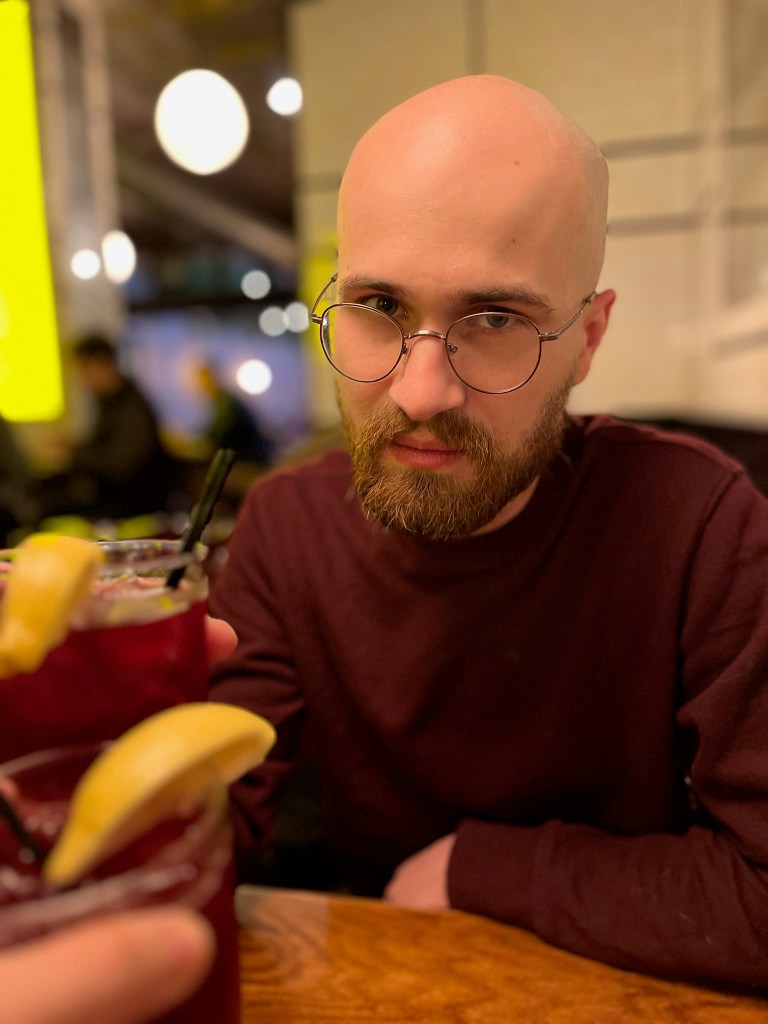
Joey Payne is an English professor. Outside of the obvious, he enjoys bicycling, walking cities, swimming, and well-written TV shows. He lives quietly with his cat. His fiction has been published by Fleas on the Dog, Light and Dark, and the Arlington Literary Journal, and others.
 the museum of americana: A LITERARY REVIEW