
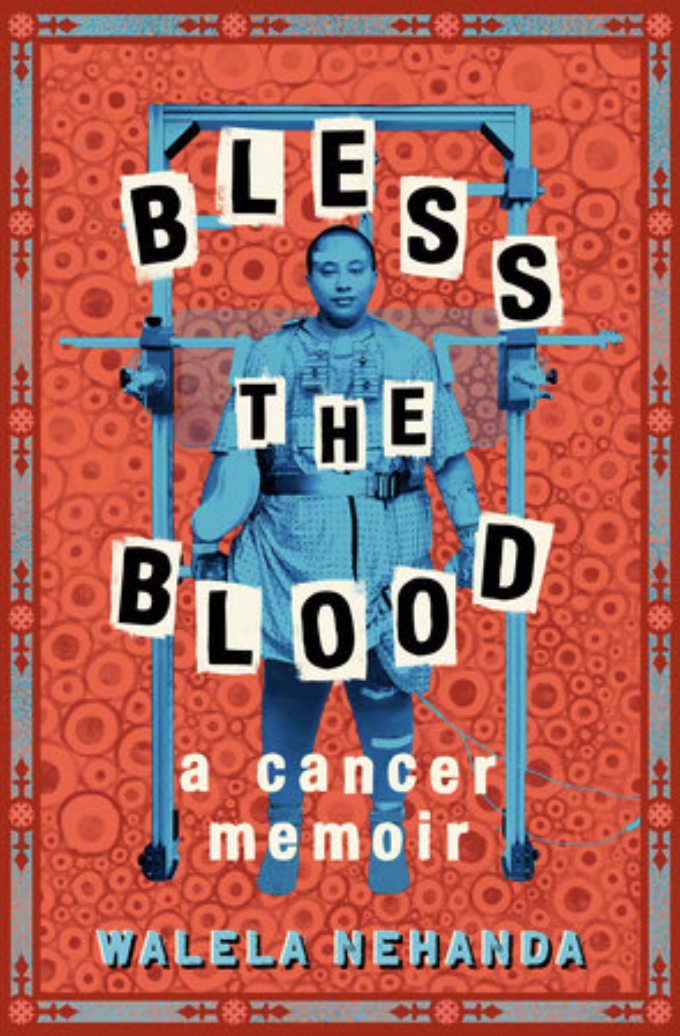
Reviewer Megan Giller interviews Walela Nehanda about Bless the Blood, a cross-genre YA memoir of poetry and essays that documents their experience living with leukemia and surviving the American medical system.
Megan Giller (MG): How did you choose the YA genre?
Walela Nehanda (WN): I felt it was important to allow younger folks to be able to handle the topics we tend to believe they can’t handle. This is a reality so many of these kids are living through. I don’t think we give youth enough credit and realize that they are in this era of mass information where a lot of them are coming into topics earlier than we did as people in our thirties.
Also I got diagnosed when I was 23, so I was already closer to their age than I am now. I felt it was important to have an unflinching account of what was happening to me, whether it was through the medical system, romantic relationships, relationship to self, relationship to ancestors, relationship to my body. I thought it was important for younger folks to have that sort of account that Audre Lorde gave me with The Cancer Journals or Assata Shakur with her autobiography. The way that someone just living is political in itself.
Sanitizing the world for children does a disservice. Then what they’re able to reference is a deep romanticization of illness and how that experience is going to be for them. It sets them up for disappointment, and this disillusionment is ultimately more dangerous.
MG: There are so many big plot points in this book. What do you see as the heart of the story: family, romantic relationships, illness, structural inequality, something else?
WN: No matter what I’m navigating, there’s a deep reaching towards dignity. We see it stripped from me in each situation, and we see me try to piece it back together. Cancer is this eruption where it starts spreading to other parts of my life, including the way I treat myself. At the heart of this is what it means to navigate a world that relies on you to not understand that you deserve to have dignity.
MG: You connect the United States’ broken medical system with systemic racism. Tell me more about how you see these intertwined.
WN: It was important to me to give a historical narrative as well to buck back against the idea that this is an anomaly. I always reference Medical Apartheid by Harriet Washington. A lot of our current analysis of medical racism makes it seem like it cropped up out of nowhere and that it is a more recent phenomenon. But the American health care system comes from chattel enslavement. What does that mean when the core of something is rooted in the oppression and experimentation and exploitation and murder of Black people? People don’t consider the ways in which chattel enslavement was justified via doctors saying a slave has drapetomania, making up a whole illness, aka “runaway slave syndrome.” That’s giving a medical diagnosis for what is a very legitimate desire. It pathologizes. Then it turns into medical schools competing with each other in the era of lynchings in America with how many corpses of Black people they can dissect. You have these images propped up next to each other: white supremacists standing with a Black person being lynched in the South and white medical students with a propped up Black person who’s dead that they’ve dissected in the North. You can’t tell the difference.
Then in the late 1980s and 1990s, the agenda was that Black people are violent and there must be policies surrounding it. For example, Hillary Clinton called Black children “super predators,” after a study claimed Black children who have relatives in prison have a gene or a chromosomal abnormality that predisposes them to violence. It’s always been this political agenda alongside health. I’m thinking of Tuskegee, which was withholding a cure from Black people in order to make it seem as though Black people were a syphilis-soaked race. We’re not ever meant to be the pinnacle of health. We’re not ever meant to be seen as human. There’s always been this zeal around the death of Black people, even within medicine. It’s unsettling to think that any part of this system is redeemable or that there isn’t a connection to settler colonialism.
When I was able to name that in the book, it became a lot more enraging. It was important to me for young folks to know that what they’re experiencing has a name and a tangible history.
MG: What kind of research did you do for your book, both in terms of U.S. history and your family’s personal history? Was your research in service of the book or part of how you were surviving your cancer experience?
WN: It was part of how I was surviving my cancer experience. Because I started getting involved in organizing around the same time I was diagnosed, I was doing a lot of political study. I was reading Assata, Kwame Ture, Frantz Fanon, Amílcar Cabral, Butch Lee, C.L.R. James, Walter Rodney. Writers like June Jordan, Audre Lorde, Lucille Clifton, Toni Morrison, and Octavia Butler.
You would think you’d learn more [about family] from actual stories being passed down, but with the Black side of my family, I learned more about them from death certificates or wars they were drafted in. There were some lovely surprises, like a whole interview with my fourth great aunt. Also being able to sit with censuses and researching the time frame in these areas where there were Black freedom colonies. The Texas Freedom Colonies Project has done a lot of great archiving work. I was able to imagine what it would be like to interact with certain ancestors that I had not met.
MG: I appreciated the realness of your depiction of how relationships are affected by illness. What do you hope readers, especially YA readers, will take away from that?
WN: When it comes to illness, it’s easy as a young person to be told, “Well, if my family is not supporting me or understanding me or loving me the way that I need to, I am therefore unlovable and this is all my fault.” I wanted to illuminate how layered it is. Oftentimes we are made responsible for people’s reactions to us when it’s ultimately not our responsibility at all. And that will dictate our self worth. I hope they can come away with that piece about dignity and knowing what they deserve when it comes to love, relationships, support, and care.
MG: I related to your statement that “depression and cancer often go together.” The reality that illness is hard on a person’s mental health, and that we’re not all grateful every moment of the day, is not talked about much. I love the way you combat the idea of the “good patient,” in terms of mental health and anger. Could you talk a little bit more about that?
WN: Rage in Black people is often seen as a reason to enact violence or withdraw care. There’s a deep, fucked-up idea of how we think someone should navigate illness, but particularly how Black people should. And I knew I was running a risk by being honest about what I went through and how I handled it. But I had not seen that talked about. I felt the reward was greater for a younger person to be able to know, “I don’t have to subscribe to these impossible standards.” Especially when a system is jerry rigged against you. In the book I’m surviving a great deal of injustices on personal, interpersonal, communal, and systemic levels.
MG: So much of what’s published now is prescriptive, and there’s a pressure to be uplifting. How did you approach writing about these topics in that climate?
WN: That prescriptive ending was something I was not satisfied with, because I found myself being pressured into it as a survivor. As I was writing this book and had survived cancer, I saw how much of survivorship is not what it’s made out to be via the cancer industry. That prescriptive ending is how I think a lot of people cope with having gone through cancer. But for me, it wasn’t enough. Being a survivor is a very different reality than what’s marketed to us. The book purposely ends on a cliffhanger, because I didn’t want to pigeonhole myself into this and because I wanted space to sit with survivorship.
MG: What’s next for you?
WN: I’m working on a second project and allowing it to be a different experience. Before, I was writing a book and didn’t know it. Now I have this idea and these themes that I want to speak to, and I want to push myself. Writing Bless the Blood was very traumatizing, where I was going into deep memories and writing from there, which I don’t recommend. Now I’m repairing that relationship with creativity. I look forward to sharing within the next year or two.
This interview has been edited and condensed for clarity.
 the museum of americana: A LITERARY REVIEW