Reviews/Interviews Editor Ann Beman interviews David Mas Masumoto about Secret Harvests, a memoir wherein the author investigates the life of a long-lost aunt and in the process sheds light on his family’s ghosts.
This issue of the museum of americana has a pronounced food theme. What is the importance of food to your family history?
Food is at the heart of my family story, my family history. We’ve been farmers and farm workers for generations, perhaps even centuries going back to Japan and ancestral lands. This sense of history is part of the foods we all need to thrive and grow, not just our physical bodies but also our emotional and social inner souls.
But the story of food goes beyond simply growing and nurturing crops. I would like to believe we grow stories, tales that feed your body and soul, words that nurture your growth and perspective. The connection between food, farming, and stories is crucial – otherwise our produce becomes merely products and our work is simply transactional, typically defined just by economics and money.
What incited you to write Secret Harvests? Was there one moment after meeting your “lost” aunt? Or did the call to write this book come in stages?
This saga unfolded like puzzle, a puzzle filled with secrets and family ties that bind us. It began as a quest to explore the mystery of a “lost” aunt separated from us for 70 years. I had only vaguely heard of her, we had no photos nor stories about her. Even after I met her in person for the first time, I still carried doubts and disbeliefs. It literally took years and the process of slowly writing notes and journal entries that this story became real.
The theme of disabilities quickly confronted my thinking and the biases I had carried. As I learned more of the story of my Aunt Shizuko and her mental disability, I began to piece together the negative baggage many families carry about a family member who was cloaked and invisible in silence. Breaking this barrier of family secrets became a slow and gradual process, like piecing together a puzzle knowing some pieces are and will always be missing.
From where does your urge to tell stories spring?
I did not grow up in a family of verbal storytellers. My home was filled with a silence that only later I learned carried a legacy of untold stories. There seems to be a subtle yet powerful force in our farm that whispers to me daily. Included is the legacy of Japanese Americans, especially those family farms who grow food and stories. A quiet voice lingers in our fields, stirs with an evening breeze, the scent of family embedded in the blossoms and fruits that are alive and beckon like a muse or siren. I can’t help but want to ask questions and that’s how my stories are born.
How is storytelling like farming?
Both have a quality of a mystery accompanied with more questions and harvests to come. A wonderful question Marcy, my wife, once posed to me: How many harvests do you have left? That question haunts me with a wonderful quality about seeing the future in the present, finding a quiet joy in the solitude of daily life in the fields and words. Each season carries meanings that can implode and explode. Every year adds to the wisdom of a piece of earth my family has slowly defined as home. It all makes for great harvests one more year, one more year.
Secret Harvests is about legacy, loss, resilience, and the meaning – and impact – of family. It’s a eulogy for your “lost” aunt Shizuko. When working with your trees, looking into their branches, do you ever lose yourself in the branching of what-ifs? What if you’d learned about Shizuko sooner? What if your parallel existences had intersected sooner?
I get lost all the time! I can’t help but see the silhouette of a tree and think of my family tree. I feel the shape, the pruning scars and the decades of hands that touched a tree and left a mark. And embedded in the curve of a branch is the sense of history and it’s filled with. . . stories!
I play out these dramas daily, reimagining what might have been and what is, constantly contemplating the journey I and my family and neighbors have been on. There is no straight linear path, rather it’s a series of dots that connect, some random, others part of an inheritance of karma, cause and effect, actions with consequences. There’s a wonderful sense of randomness and yet destiny at play.
What if I had learned of Shizuko earlier? Would I have been mature enough to accept her fate and destiny. . . or would I have been angry and outspoken? What response would my family have reacted to a younger, more aggressive and inquisitive Mas? That would have been a different story – not better or worse but a different time in my family’s saga and a different Mas.
In the book, you talk about grafting the trees on your farm. How is that process similar to writing? Is there grafting in your word work?
Grafting is an art, like writing. And I’m only a “C” level grafter, only about 60% to 70% of my grafts take. So like writing, I struggle to perfect my craft knowing well I will never be perfect, yet I keep trying. And I enjoy the fruits of my labor when a graft does “take” and a fully grown tree sprouts from a tiny, skinny branch/scion. Practice, practice, practice. Like draft after draft after draft.
What does a day in the life of a poet farmer look like? What is your writing practice like? How do you balance farming and writing?
My body wakes up early daily, over trained by decades of too much physical work yet it keeps me fairly healthy. I try to write in the morning before heading out into the fields. In the spring, farm work begins to dominate my time – part of the theory that mistakes made in spring will be amplified at harvest. Summer is demanding with long days and short nights – I write a lot via notes and thoughts anchored in the sweat and flavors of harvest time. I try to write more in the fall and winter. Long nights work well!
What is your definition of Americana? Does this book fit into that definition? How so?
Americana embodies the soul and culture of a nation, including the sense of history that defines us and drives us. At the heart of Secret Harvests is a legacy of stories and something as basic as this idea: “every family has secrets” – and that too is at the heart of Americana. All our voices matter, even those hidden and invisible, quiet and too often ignored. Now is the moment to speak out, listen, and reimagine.
Do you have projects in the works? What’s next?
My daughter, Nikiko, and I recently finished a children’s book and we are now working with a wonderful illustrator. The title is: Every Peach Is a Story and should be published in spring of 2025. I’m also exploring some different ideas from perhaps a graphic-novel-style book to a collection of essays about the awe of life.
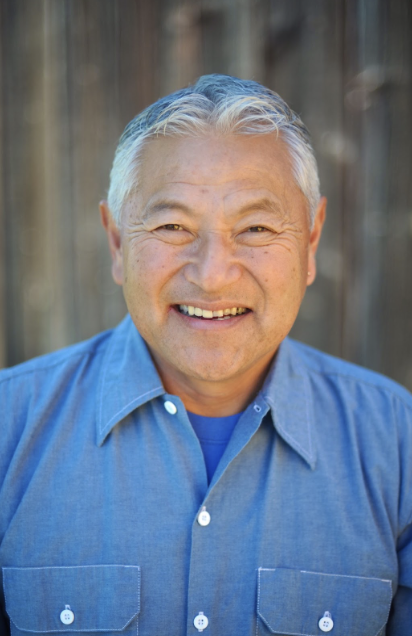
David Mas Masumoto is an organic farmer, author, and activist. His book Epitaph for a Peach won the Julia Child Cookbook award and was a finalist for a James Beard award. His writing has been awarded a Commonwealth Club of California silver medal and the Independent Publisher Books bronze medal. He has been honored by Rodale Institute as an “Organic Pioneer.” He has served on the boards of the James Irvine Foundation, Public Policy Institute of California, Cal Humanities, and the National Council on the Arts with nomination by President Obama. He farms with his wife Marcy and two adult children, Nikiko and Koro. They reside in a hundred-year-old farmhouse surrounded by their eighty-acre organic peach, nectarine, apricot, and raisin farm outside of Fresno, California.
 the museum of americana: A LITERARY REVIEW