Reviews/Interviews Editor Ann Beman interviews Brooke Champagne about NOLA Face, a hilarious, heartbreaking collection of essays tracing the evolutions of the author’s girlhood of competing languages, ethnicities, aesthetics, politics, and class constraints against the backdrop of a boozy New Orleans upbringing.
What incited you to write this book? Was there one essay or a group of them that ignited this project?
This might sound counterintuitive, but I absolutely did not know that Nola Face was a book until “Nola Face,” the last essay I wrote for the collection, was completed. All the others had been written, and many published, over the previous decade, but something about writing that final essay felt like it was a culmination of all things I had to say about my place of birth and how I’ve loved and lost the people (and animals) within it. My previous works seemed to be set in relief, like this one was pulling them all together, tying them up with this final ribbon of trauma and hope.
I heard the wonderful essayist Sue William Silverman say recently on Ronit Plank’s Let’s Talk Memoir podcast that she finds it easier to enter into a new book project basically fumbling in the dark, having no real set plan for what you intend to do. This was certainly the case for me with Nola Face, and then again, this not-knowing meant the project took quite a long time to finish. Which I am fine with! With exclamation points to prove it!
In the Note from the Author, you allude to “memory’s many vagaries, discussed frequently throughout the book.” What are the biggest challenges these vagaries present? What were the biggest surprises?
Oh Ann, I could write another book attempting to respond to this beautiful question. I suppose the biggest challenge is that there is no such thing as getting memories perfectly right, and this may upset people involved in those memories, whose own ideas of “what really happened” may also change over time. (Sidebar: I’m writing an essay for my next collection about the tiny number of humans diagnosed with HSAM, which is highly-superior autobiographical memory. Their hippocampus actually does work more like a recording device than yours and mine does, so they remember with intense specificity nearly every past moment of their lives. I can see a lot of problems with that having that kind of memory, but it would be worth it because when recalling an event, there’s no quibbling: you’re never wrong. Which supports my theory that much of the HSAM population must be a-holes.)
It’s also a challenge to create a narrative with a particular memory in mind, and then find out through research that it didn’t happen that way at all. This used to make me throw up my hands and want to give up on a particular essay or my memory entirely. But one of the surprises while writing this book is that it’s actually more interesting to lean into these memory mistakes. The less accurate version can sit side-by-side with the truer one and they can complement each other—why was my memory wrong, anyway? What does that say about my concerns at the time, or how I would’ve preferred for this to play out rather than how it did? Many of my essays tackle these questions, but I think “Bobbitt” is where I finally reconcile false memories with actual ones. This reconciliation allowed me to relax a bit about the way I treat memories in general; I’m just one person, here’s how I remember it, sometimes I’ll offer you other versions, I’ll always tell the truth to the best of my ability.
Can you speak a little bit about the development of the collection?
As I mentioned earlier, I wrote the collection slowly over about a decade with no set goal in mind of what it was going to be. I kept telling people I was writing a memoir about my abuela, Lala, but then other ideas just kept creeping in and not letting go. Characters like my father and mother wanted to dominate certain lines of thinking, and cross-pollinating with what I had to say about certain aspects of our culture, like generational divides, or domestic violence, or cursing, along with many other topics. In other words, I was becoming an essayist while working on this project that started as memoir. Of course these essays are memoirs, too, but always ideas and questions pervaded: why did I view this situation in this particular way, and not another way? Why did I lie/steal/stay silent when I shouldn’t have? Why do our relationships work the way they work? Along with telling stories, I had a lot of questions to ask myself, if not necessarily answer. In fact, the asking of questions usually brought about more questions, and fewer answers. But I hope that the way I’ve arranged the collection, it’s taking the reader on a fun ride of the mind.
When and how did the collection’s organization and form come about?
I can say organization for sure came last. When I finished writing “Nola Face” the essay, I sensed I was *almost there* in terms of having a full manuscript, which I then printed out and studied a draft of the table of contents (essentially just the list of completed essays) like they were ancient runes, and tried to decipher where there were connections or breaks in ideas. I filled out the first Excel spread sheet of my life with general themes running across the top tabs, and then the list of essays running down the sides. I checked off fields accordingly and noted overlaps. I even created fields that listed the first and last lines of each essay, and a field of keywords within each essay, to even further understand the narrative progression. This was how I gleaned the general essay order, though I still sensed something missing, which was the initial handshake with the reader: here’s what you’re getting into with this book, here is my voice, my style, my insecurities wrapped up as an opening gambit for you. I wrote the introduction to serve as that handshake, and two interstitial essays that worked as check-ins to establish new lines of questioning for subsequent sections of the book.
In your intro, you talk about needing a day-pass from teaching. I immediately thought of the last essay collection I reviewed for the museum of americana. It was Sean Enfield’s Holy American Burnout!, wherein he writes at length about teacher burnout. What would you say is your antidote to burnout, either as a teacher, or as a writer?
That collection sounds freaking awesome and I have just clicked Order Now. To answer your question: summers help. To avoid burnout each fall and spring semester, something that has always helped me is to align my teaching with what I want to accomplish myself as a writer. So I assign prompts that serve not just my students, but me. I work alongside them. I engage in as many collaborative projects in the classroom as possible so it feels like we’re all in this together rather than engaging in the fantasy that I, as teacher, am some font of wisdom that will pour into them all the secrets of becoming a great writer. There’s no secret, just the stubborn, dogged commitment to the work, day after thankless day, for little (or no!) reward. And that’s fine with me. Shortly after my MFA, I realized how little the world needed my words (how did I not know before?). I was living in Rejection City, Who-Even-Cares-Land, wah-wah-wah. So I announced sternly, proudly, and only to myself, that I was (palm to forehead) giving up on writing. Hilariously, this decree to give up writing was something I wrote down in my journal. But the thing was, I just couldn’t stop. Something would happen in my life, or to my family, or in the culture, and I’d need a place to step back and observe it. So I’d do it on the page, composing many drafts of…I don’t know quite what I was doing then. But I told myself it wasn’t real writing because I wasn’t trying to publish it. Come to think of it, that might be the most *real* kind of writing. In terms of avoiding writer burnout, it’s okay and even healthy for me to walk away from a particular piece I’m stuck on. I’ll go flirt with some other writing project or piece. The thing I’m struggling with will always be there, and some distance almost always helps me elucidate and even solve some of the problems therein.
In that intro, you also say, “Discovering truths behind facades is one of teaching’s, and life’s, greatest surprises and joys.” No question. It just made me realize why I am a Brooke Champagne fan.
Thank you for saying that! It’s one of the implicit mantras of the book, so seeing that this idea resonated with you early on brings me much joy (and relief).
In “Cielito Lindo,” you throw a chancleta reference at us. “She [Lala] can silence me like no one else by simply removing her chancleta.” What’s your favorite chancleta story when it comes to your grandmother Lala?
Haha! I just remember how big her eyes would get, like they were taking over her head. I don’t believe she ever slapped me with a chancleta, and it became a joke, her taking it off and waving it in front of my face. She basically said, “there’s no way I can spank you with this, you’re too sweet.” My older male cousins who would visit every summer from New York, however, weren’t as lucky. (Or as sweet.) They got chancletas across las nalgas (butt) quite often. Lala also had these wooden carvings hanging on her walls: a ginormous fork and a spoon and a knife. I remember her once taking down the spoon and chasing my cousin Steven across the house with it. I can’t remember if she caught him, but somehow, I think so. She was short, and much slower than him, but that woman never gave up on any challenge.
In “Cielito Lindo,” Lala insists you “do too much asking-questions and not enough feeling-feelings.” Is this still true? How has it changed? And what does this mean for your writing?
I love this difficult-to-answer question. The job of the essayist is to ask the questions, whereas the job of the human, in the moment, is to feel the feelings. I was an analytic and probably strange child, so I think I was more comfortable in my early youth with asking questions rather than feeling feelings, because those were dangerous; they could get out of control. Other writers might relate to the dual presence/absence they feel in any discrete experience. I’ll give an example: I recently visited my father at a physical rehab facility, because a few weeks ago he broke his left shoulder and right leg when he tripped over a wooden pallet at Walmart (long story, but in short: he’d just finished reading my book when he stumbled disastrously—hi, Dr. Freud!—, also his lawyer’s name is Mama Justice, and also none of this is a joke). It was his birthday and I brought him fourteen paperbacks and a baseball cap. Over the course of my hour visit, he declared that my book, which we were discussing for the first time, just didn’t hold his interest. Oh, not the parts about him, those were gold…in fact if all of Nola Face were about him, it would be a bestseller. I considered, briefly, breaking his other leg (kidding, kidding!). I tell this story because 1) it’s already an essay in-progress for my next book, and 2) this kind of thing happens to me often: some occurrence reveals itself instantly to be A Subject, so I’m half out-of-body while it’s happening, writing it out in my mind. In fact, I drove the hour home from the rehab clinic dictating ideas and verbatim lines into my Notes app. I suppose what I’m saying is that the prospect of writing my pain lessens the actual feeling of that pain, and I don’t know…if that’s wrong, I don’t want to be right.
You know that one of my two favorite essays in the collection is “What I Know About the Chicken Lady.” Talk about conveying your father’s stories in italics. Why that choice?
I’m so pleased you love this essay and appreciate your publishing it [in Los Angeles Review] quite a few moons ago. This was one of the earliest essays about my father I ever finished, and what I wanted to convey was the feeling that, whenever I’m speaking with him, he becomes this dominant force that takes over everything. He is the one with personality, ideas, experiences, funny anecdotes, and I’m one giant, silent ear-like receptacle. Anyone who knows me would not describe me so passively, but this is simply the relationship I have with the man. He’s always tacitly demanded my enrapture, and I’ve always openly supplied it. So I wanted the actual text to show that even in ordinary conversation, he speaks in a way that insists on being heard and adored (if only by me). Also there’s something about how discrete alphabetic characters change personalities when they’re italicized, like they’re leaning over and a little wobbly. They read to me as the drunkest font, so this matches my father for reasons you and any “Chicken Lady” reader well knows.
Is there a NOLA Face playlist?
Last semester I offered my grad students an optional assignment to create a playlist for their books-in-progress, and I subsequently became super annoyed I never did this for myself. But your question has me excitedly flipping through certain essays that would do well to have some beats behind them. So in no particular order, here are some songs that pair well with Nola Face’s themes and heart: Pedro Infante’s “Amorcito Corazon,” Buffalo Tom’s “Late at Night,” Eminem’s “8 Mile,” Bob Dylan’s “Not Dark Yet,” Taylor Swift’s “marjorie,” “Cielito Lindo,” Mos Def’s “Close Edge,” Simple Mind’s “Don’t You (Forget About Me),” Aimee Mann’s “One,” Beyonce’s “PROTECTOR.” I’m sure there are many more, but these ten felt like a nice, round number.
How do you feel about the word ‘Americana’? What’s your definition of americana and how does NOLA Face fit into that definition?
If there’s an award for being the least knowledgeable about this particular term, I am likely to win it, but I will plow ahead (without conducting research) nonetheless. I feel like “americana” represents more of the authenticity of Americanness, all that ephemera that’s part of our daily living. It seems the obverse of our idea of “American exceptionalism,” which essentially states “look at how morally exemplary we are.” I hope Nola Face fits this “americana” definition, because a major recurring theme is recognizing what and who we are for real, and not the performative, social-media-built, idealistic ways in which we view ourselves. It’s understanding we cannot help who we are or who we love.
And, forgive me, but since you’re asking this question in 2024, when I hear the term, the first thing I think of “Miss Americana and the Heartbreak Prince” (my daughter’s favorite Taylor Swift song).
Do you have projects in the works? What are you working on now?
I’m working on two projects concurrently, both of them in the memoir/essay field. (BTW I must be some kind of psycho, because plenty of my memoirist friends will write their books and then need to take a break to work on fiction or poetry or whatever, and I’m like: please, brain, give me two more nonfiction books to write, bring on all the I’s!). The first project is, in a way, a follow up to Nola Face, a book of essays using metaphors to describe the body, and it’s titled Your Bones are My Bones. One of the essays centers on Lala’s legs, and there’s one about my husband’s facial hair, and another about my father’s blood. Also the essay I’m currently working on is proving to be a lot of fun. It’s called “55 Vaginas,” which I’ve discovered is just about the total number of vaginas any essay can hold (to learn the context of all these vaginas, stay tuned for my next book!). The other book is a memoir-in-profiles about New Orleans Saints fandom, through profiles of my beloved dead and dying New Orleanians, titled Lives of the Aints.
If it sounds like I’m being uber-productive, omg thank you for believing that, but also, throwing myself into new work is far preferable to marketing my old work. Not trying to be precious about book salesmanship, and by the way, if you’re reading this, I truly hope you purchase (and love) Nola Face. But every time I make an earnest gesture in that direction I feel like that guy from the 80s infomercial, “Please, try my product.” Ugh, it’s enough to give my own self douche chills.
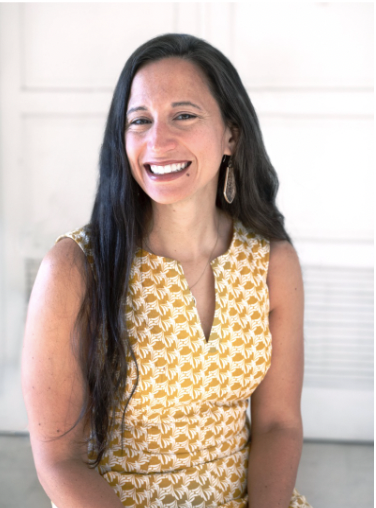
Brooke Champagne is the author of Nola Face: A Latina’s Life in the Big Easy. Her writing appears widely in literary journals and has received various awards, including the inaugural William Bradley Prize for the Essay for her work “Exercises.” She won the 2022 March Faxness National Championship Essay Tournament with her essay on Aimee Mann’s cover of the song “One.” Her essays have been selected as Notables in several editions of Best American Essays. She is the recipient of the 2023-2024 Alabama State Council on the Arts Literary Fellowship in Prose. She lives with her husband and children in Tuscaloosa, where she is an Assistant Professor of English in the MFA Program in creative writing at the University of Alabama.
 the museum of americana: A LITERARY REVIEW