

X
When they began to emerge, I had dreams of their white bodies climbing out of hard shells. I took walks around the neighborhood and measured how loud their singing was. I made a linocut print of Magicicada septindecim. I had their form indelibly drawn on my body. This emergence of Brood X cicadas felt the space between religion and celebration, which turned out to be how the Greeks and others felt about cicadas, too. As I read about biblical, historical, and mythological cicadas, I began to wonder whether we had to believe in some higher power to emerge through difficult times.
X
Reverend Andreas Sandel had cast himself into the wilderness. North America wasn’t the desert, but it was desolate compared to Stockholm. When Sandel arrived in Philadelphia in 1702, he found a city that was no more than a town, a collection of buildings with a few thousand residents. His home congregation was that of Gloria Dei in Philadelphia, where he preached in Swedish, but he traveled in the Delaware Valley, visiting Swedish colonists at their homes, baptizing babies and performing marriages, perhaps bringing a comfort of the old world during his eighteen years in the colony.
In the winter of 1708, Sandel fell ill and was sick for three weeks, and he wasn’t the only one: “It has been very sickly in Philadelphia this Winter and many have died,” he wrote in his journal. It would be fifty years before the city had a hospital, and ninety years later, on the eve of the city’s great yellow fever epidemic, there was still no water system—only a single sewer that invited mosquitos and bred diseases. Smallpox, measles, influenza, yellow fever, scarlet fever, and other illnesses there were yet names for, spread through air, water, and on carriers, including insects. There were no treatments, no cures. In Swedish, plåga is a noun that means plague as well as a verb that means torture.
Sandel knew the story of Eyptens tio plågor, but didn’t call the illnesses of North America plagues. At the time, diseases were considered a predetermined part of life. And when the cicadas came, Sandel’s journal contained no mention of Moses, God, the King of Egypt, or the plagues that came when Moses failed to free the Israelites. Sandel didn’t mention the river that turned to blood, then frogs, flies, and mosquitoes that came before a hailstorm rained down. He said nothing of those who got sick. Or how, when the locusts came, they ate every blade of grass.
“In this month, some singular flies came out of the ground,” he wrote in May 1715. They must have left little holes in the dirt roads and the earth that surrounded the trees in the woods, and Sandel couldn’t help but be amazed by their emergence. “It seemed most wonderful how being covered with the shell they were able to burrow their way in the hard ground,” he wrote. They “made a peculiar noise” so loud it made “cow-bells inaudible in the woods.”
“The English call them locusts,” he wrote, and there was a biblical element to their arrival. After two centuries, there still is: when I see ten or fifteen clustered together on a small branch, it’s hard not to perceive them as the creatures sent by God. Sandel observed that at this stage, cicadas made slits in the tree branches, “where they deposited their worms,” which caused the branches to fall and leaves to wither.
These were neither flies nor locusts. The entries in Sandel’s journal are the first written record of the mid-Atlantic seventeen-year cicadas. Though Native Americans had seen these cicadas appear for generations before the English and Swedish arrived with diseases, guns, and claims on their land. The periodic cicadas have been emerging every seventeen years for millions of years and have been given the name Brood X. A plague is quick, something that arrives all at once and destroys. A brood is slow, something that has taken time to develop.
Early inhabitants of Philadelphia “split them open and eat them,” believing they were “of the same kind as those said to have been eaten by John the Baptist,” Sandel wrote, referring to the ascetic’s isolation in the wilderness, where he survived on wild honey and locusts. John believed God would bring a cataclysmic event to solve the problems of the world. To repent and prepare for judgment from God, his disciples fasted and bathed in water. Along the Delaware River in what had once been New Sweden, baptism, eating cicadas, and going to church on Sunday brought God to the people and helped them overcome the tortures of the New World: the diseases, the uncertainties, the fires, the storms, the possessions by the devil.
X
In the valley of Nysa, Dionysus knew neither his mother nor father, mortals nor other gods. Just before his mother Semele gave birth to him, Zeus snatched him away, knowing she, and the infant, might die. In her jealous tolerance of Zeus’s womanizing—that always led to passive-aggressive acts against the women—Hera had planted the idea in Semele’s head that she wanted to see Zeus in all his glory, not cloaked as a mortal or animal. Semele would die when she saw Zeus, and all the god could do was save his son. Dionysus was subsequently raised by nymphs, and became a god despite his mortal mother.
Dionysus wandered into the world of men and taught them the wonders of wine, and they worshiped him for it. Like the followers of John the Baptist, the most devoted followers of Dionysus sought a type of purity. They didn’t want the city and the temples, they wanted the untouched woods and wilderness. They were called Maenads, and in the forest they found ecstatic joy with Dionysus. The later followers of Dionysus would replicate this frenzy, dancing and drinking themselves into a euphoria to get closer to their god.
Although lesser gods themselves, the Muses have become associated with Dionysus because they inspire music and dance, those things that make trances and worship to the god of wine possible. Plato writes that the Muses who became wild and “ravished with delight, and singing always, never thought of eating and drinking” until they died and were resurrected as cicadas, and in this form, could spend their time singing.
The Greeks obsessed over both the cicadas’ song and their beauty; the insects appear on coins from 500 B.C., and on golden hairpins; the lyric poet Anacreon wrote “Ode to the Cicada,” with the lines, “like any king thou singest…and thou art honored among men…Almost thou art like the gods.” The cicadas of the Greeks were not the species that Reverend Sandel recorded. This celebration was of the Tibicen genus, a creature with a brown body and brownish translucent wings that appears in the hottest months of the Mediterranean summer. Brood X is the genus Magicicada.
X
By 1834, North America wasn’t as foreign as it had been in Sandel’s time, but Charles Joseph La Trobe could still write about his travels through the United States. La Trobe, a Britishman of French Hugeunot descent and member of the Moravian Church, thought the periodic cicada a “pretty insect.” The nymphs, the immature stage between a larva and an adult, emerge white and fleshy. They break open through their own skin and quickly darken to a deep black, with bright red eyes and orange wings that shine in the sun.
“The fact of its occasional appearance, as though by magic, in such vast swarms, had caused it to be familiarly alluded to by that name,” he wrote. La Trobe had been raised in the Moravian Church, whose headquarters were called Herrnhut, a place under the care of the Lord. Moravian missionaries around the world saw what they thought to be magic in the religions of Native Americans, the enslaved in America, and across Asian cultures and wanted to excise it in favor of the worship of God and Jesus.
The genus of all periodic cicadas is Magicicada, a perfect portmanteau of how they come to be and what they are. Scientists are still unable to fully explain how Magicicada broods emerge— all at once and in seventeen and thirteen-year intervals. What I find more amazing is that each brood is made up of multiple species. Brood X is Magicicada septindecim, Magicicada septendecula, and Magicicada cassinnii, strains who emerge together yet sing different songs and cannot reproduce with one another. Evolution must explain their life cycle, but as with unseen and often incomprehensible realities, it feels like it must be supernatural.
Both witches and sorcerers use magic, but according to I.M. Lewis in Ecstatic Religion, witches use only their thoughts to harm, while sorcerers use “observable techniques–spells, potions, and other dark acts” to do the same. Why must magic be harmful? Where are the lines between witchcraft and sorcery and religion? A prayer can be a dance; we move in the same way over and over to enter a trance state so we can speak with God, perhaps aided by wine or drugs. That was what the Maenads and followers of Dionysus did. A prayer can be a spell; we repeat a phrase to talk to God, so that he will hear us and grant us redemption or health or better days. That was what Sandel’s parishioners did. A prayer is magic; this act invites the supernatural to change our reality.
X
They sound like a pulse of the blender, a wave crashing on the sand, one deep breath. Their song grows together, reaches a peak, then recedes. It’s an undulation that is incredibly loud and yet can fall into the background if you let it.
The call of a solitary male cicada is like a siren. He lets out a high whine, followed by a clicking or a note that quickly dips to a lower note, exactly at an interval that makes humans uncomfortable. Yet when cicadas sing together, these sonic differences are barely noticeable.
I sit on my porch and watch them. After the swell of sound, they move. Collectively, they float from branch to branch, then call out to one another again. They have spent so much time alone buried in a web of roots and mycelia, and yet now sing and move together seeming effortlessness.
They are the descendants of the cicadas Sandel and La Trobe saw. Seventeen years ago, they fell from the branches where they were born. I saw them then, too, and if I didn’t look carefully, I might have mistaken them for maggots, with rounded translucent-white bodies. But these have six legs, and with those legs, they dig into the earth, to feed on trees until they are grown. But even then, if they are ready, they don’t emerge. The cicadas wait for everyone else and dig their way out as a collective brood, in this second summer of the plague.
X
Each member of Brood X lives seventeen years, a span for which they exist almost entirely on their own. When they are born, like Dionysus, their mother is dead, obliterated in a final sacrifice for her child. Like Moses, they are cast into the dirt, alone. They feed on sweet roots, like John the Baptist suckled on honey. These men hid to survive, and emerged to preach a gospel. The cicadas hide to grow, and emerge to sing and produce another generation.
X
We had been in hiding, but at the end of 2020, a potion gave us hope. Five months later, I carved a linoleum block with the figure of a cicada, printed the image on cards, and sent them to friends, even to those who didn’t live among Brood X. Throughout the pandemic I had been sending cards, always signing off with, “Hope to see you soon.” That phrase, continually repeated, was meant to betoken reality, and now it had.
One night, I painted my nails red, stepped into orange shoes, and put on a black dress with white polka dots and flowing sleeves: the closest I could get to being a Magicicada. At the bar in the back of my favorite bookstore, we celebrated. Vaccinated regulars sipped cicada beer and cocktails with a cicada encased in ice and two watermelon balls, meant to look like their eyes. I hugged people I had only seen on screens for the last year. We talked loudly with strangers. It was magical. I was surrounded by people, and many of them had indelibly marked themselves with a cicada.
X
They appeared on Instagram like real cicadas, first one, then another, and before long, they were everywhere. My friends had chosen to put a lasting memory of Brood X on their bodies, and the tattooer wrote that he was “blown away by the enthusiasm” and that he’d keep tattooing the same cicada he’d designed for the occasion as long as his followers were interested.
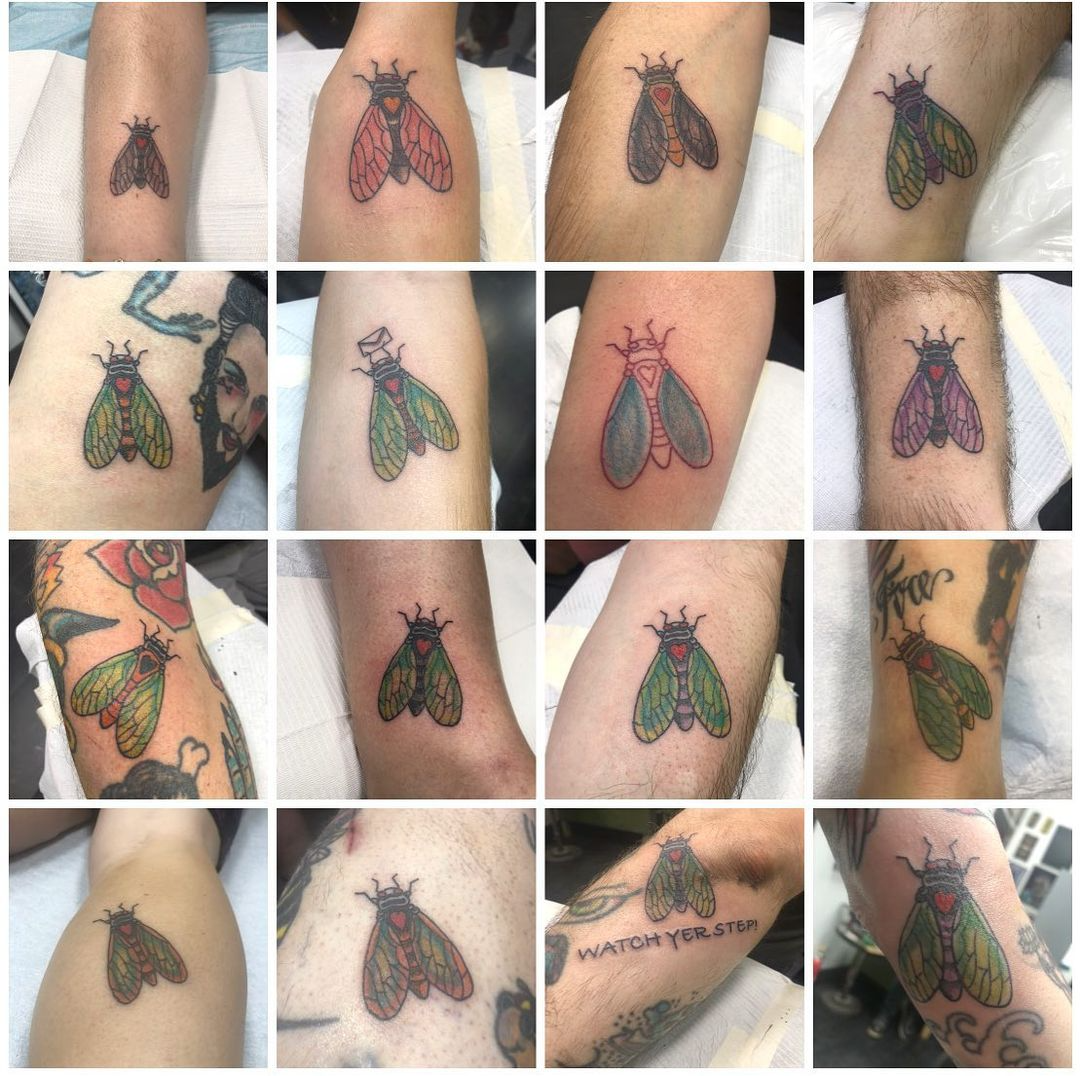
When I arrived at the tattoo studio on a Monday morning, the artist told me he’d been working all weekend. “You’re number 196.” He’d used the same pattern 196 times on 196 arms, torsos, and legs, slightly changing the colors for each customer. I didn’t doubt he’d reach 300 before the last Magicicada stopped singing and their seventeen-year life cycle would begin again.
X
If our bodies become mummified and we’re found at some later date, the archeologists will think that we were in a cult together.
X
A few weeks later and I can tell the cicadas are dying. They are already much quieter. I can still hear a chorus in the trees and a single cicada singing as he sits outside my window. I can smell the decay and must avoid crunching the dead bodies that litter the sidewalk. I see branches that have fallen to the ground, the branches upon which the smallest nymphs will hatch, then dig their way underground.
I think this will be a cicada year we will remember. I will have the tattoo on my arm. Others will have the songs they wrote, the art they created, and the photographs they took. There was something about the cicadas’ emergence, the magic of how they disappeared then came out of the ground seventeen years later that inspired us, that felt true in this moment as we too tried to reemerge, as we tried to imagine that in seventeen years, we might still be here, and even if we didn’t believe in God, we believed in magic or science or some higher power that might yet save us.
~~~

Kristina R. Gaddy is the author of Well of Souls: Uncovering the Banjo’s Hidden History and Flowers in the Gutter: The True Story of the Edelweiss Pirates, Teenagers Who Resisted the Nazis. She has received a Logan Nonfiction Fellowship and Robert W. Deutsch Foundation Rubys artist award, and lives in Baltimore.
 the museum of americana: A LITERARY REVIEW