
Trav’lin Light, by Shaun Turner
I’m hopelessly clumsy. My daddy used to say that I looked like a barn cat—my shoulders up, couldn’t walk in a straight line if my life depended on it. I didn’t have the grace of my younger sister, who, like a dandelion seed, would flit through the summer heat on her tip-toes, the muggy Kentucky air thick around me like syrup.
We lived in a one-factory town—Han-D-Wipe, which made moistened paper towels. Our parents had moved us into the upstairs apartment of an old white house that sagged in the middle from rot. Behind the building, a wooded patch led to a mossy brick wall and a warehouse sandlot. Beyond that, fields. The neighborhood kids would spend their summers bunched together in between the trees, picking up and throwing slender pieces of shale, and turning the shards in our hands like precious things.
The summer I turned fourteen, I decided I was too big to squat in the dirt with the others. Instead, I walked around the city streets and watched people—the old men in white shirts who took to sitting on their stoops, and the women in sundresses who pushed strollers around the park for hours, and the faceless working men and women who hummed like bees, clustered around the factory gates.
I decided I was too big for that one-light town, too. Too big for the sandlot and too small for that factory.
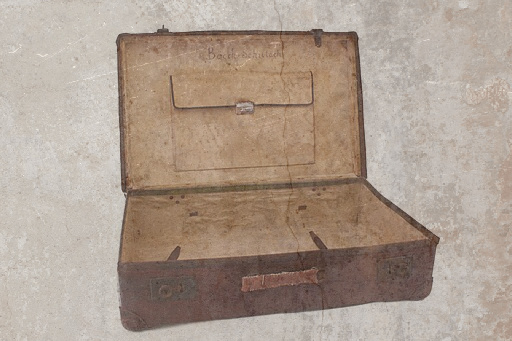
I took my daddy’s old gray leatherette suitcase and I stuffed it full of clothes—just a mess of things. One single sock. Three pairs of underwear, one which had to have been my sister’s. And only three shirts. A pair of shorts and a black skirt and a tank top.
I walked to the Greyhound stop—a kiosk next to a payphone—and climbed on the bus.
The bus smelt like soup, and it rocked back and forth like a boat on a lake. My stomach felt hollow, like a kettle drum, especially when we lurched to a stop in front of the white marble courthouse. An old woman climbed on, paid the driver, and sat beside me.
Then the bus stumbled onto the highway, eased into the flow of traffic, and I decided to relax, to take a closer look at this woman. She wore a suit, gray-clad all over, her silver hair permed up.
She turned to me and said, “It’s been a hot one.”
I didn’t respond.
“Where are you off to?”
“To visit my mother,” I said, even though it wasn’t true. I clutched my daddy’s suitcase against my chest and I watched the land pass by. It was calming, somehow, that the road kept on going, past the fragrant rows of tobacco and further away from town.
The old lady’s head bent down, and she began to snore.
Across from us, a young man took up two seats with the wide spread of his legs, oblivious with his forehead against the window. He inhaled and exhaled like the ticking of some clock, and I noticed how his foot tapped—slow, but to his private beat.
I watched the landscape darken outside the bus window—the trees became silhouettes against the sky, and all around us, headlights illuminated the dark in frenetic blurs.
If only I could be light in motion.
The shadows crept over the fields, the once vibrant green now muted and dull. We grew further and further from home.
I looked down at my hands and noticed how they shook.
Hours later, the bus pulled into another small town, and the old woman beside me stirred awake. She wished me luck, and I thanked her before stepping off the bus.
I stood on the sidewalk feeling the cool breeze on my face and the weight of the suitcase in my hand. I walked until I found a small park, deserted except for a couple of stray cats. I sat down on a bench, and in the quiet of the night, I opened my suitcase and rifled through my meager belongings: mismatched clothes, a coin purse with a few folded bills I’d saved. And that’s when I saw it—a small journal that I had forgotten I had packed. I flipped through its pages, looking for something to tell me what to do.
Its pages were blank, except for a few moments where I’d attempted to put pen to paper and scribbled circles. That, and one sentence I’d pulled from somewhere: “Grief is something that you make.”
The night wasn’t cold, but still I shivered in the dark. I wondered what my parents were thinking, and my sister. I decided not to care. Before too long, the light of the morning would travel across the sky, streaking it pink and orange, and I’d have to decide which way to go.
But there was some kind of grace in the act of running—not away, but toward something big—that pulled me to my feet and back toward the Greyhound stop, where a silver bullet would come and carry me where all the light goes—onward into a vast and unknowable space.
~~~

Shaun Turner is a recipient of an Emerging Artist Award from the Kentucky Arts Council. He is Fiction Editor for Stirring: A Literary Collection. His writing can be found in Still: The Journal, Bayou Magazine, and the Appalachian Review, where he won the Denny C. Plattner Award in Fiction, among others.
 the museum of americana: A LITERARY REVIEW